
Custom Software Development Should Remove Business Friction
Custom Software Development Should Remove Business Friction, Not Create More Work
Most custom software development projects do not really start with software.
They start with a business problem that has become annoying enough, expensive enough, or risky enough that people finally decide it needs to be fixed properly.
That is usually the real beginning.
Not the tech stack. Not the framework. Not whether the product should be built on AWS, Azure, React, Python, or whatever else is popular that month.
The real beginning is usually much more ordinary.
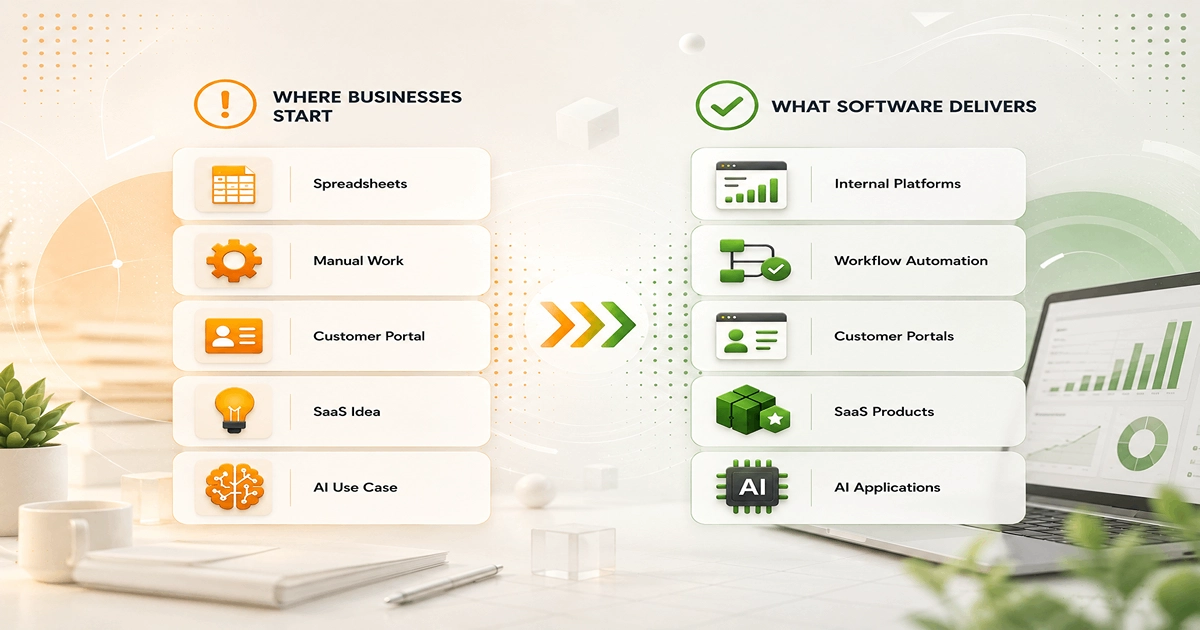
A team is still running an important process in spreadsheets.
Customers keep asking for the same update again and again.
A business wants to use AI, but the actual use case is not clear yet.
A founder has a SaaS product idea, but the first version is still blurry.
Operations depends on someone manually moving data from one place to another.
That is where custom software starts making sense.
Not because someone wants to “digitally transform,” but because something inside the business is creating friction.
And friction gets expensive.
That is the part many software development conversations miss.
People often jump straight to features.
Maybe all of those are needed.
But before discussing features, the better question is much simpler:
What business friction are we trying to remove?
If that answer is not clear, the project can very quickly become a collection of screens and features that look useful, but do not really change how the business works.
Good Business Software Has a Clear Before and After
A useful software project should have a clear before and after story.
That shift is important because the goal is not just to build software.
The goal is to remove friction from the business.
Good business software should make something easier, faster, clearer, or more reliable. If it only adds another system people have to manage, then it has probably missed the point.
Why Custom Software Projects Get Messy
Custom software projects usually get messy when teams start building before the problem is clear enough.
A team gets excited. Everyone wants to move quickly. The idea feels clear enough. Development starts.
Then, halfway through the project, the real questions show up.
Who exactly is using this?
What happens before this step?
What happens after it?
Who approves this?
Which system owns this data?
What should be in version one?
What should wait?
What happens if the business grows?
None of these are small questions. They shape the whole product.
When they are answered too late, the project starts drifting.
The team starts spending more time managing confusion than building the product.
That is why clarity before code matters.
It is not about slowing the project down. It is about preventing the wrong project from moving too fast.
The Tech Stack Comes After the Business Problem
Technology matters.
But technology should support the business outcome, not lead the conversation too early.
Before choosing tools, frameworks, or platforms, a software development team should understand the business workflow clearly.
What problem are we solving?
Who will use this software?
What workflow are we improving?
What should be included in the first version?
What can wait?
What does success look like?
What systems need to be connected?
Where are the delivery risks?
Once those answers are clear, technical decisions become much more useful.
Without that clarity, even good engineering can end up building the wrong thing.
The First Version of Software Matters
One of the hardest parts of software product development is deciding what not to build.
Most teams try to put too much into the first version. That is understandable.
Why it happens
But the first version should not try to solve everything.
It should solve the right problem well enough to:
Create value
Get feedback
Move the business forward
That is especially important for:
These products usually evolve after launch.
A good first version should be focused enough to launch and strong enough to grow.
That balance is where planning, architecture, and product thinking make a real difference.
Where a Software Product Development Partner Helps
There is a difference between hiring developers and working with a software product development partner.
A development team can build what is requested.
A product development partner should help make sure the right thing is being built in the first place.
That means:
Asking better questions early
Challenging unclear scope
Thinking through workflows before screens
Deciding what belongs in version one and what can wait
Identifying architecture and integration risks before development starts
Creating milestones that both business and technical teams understand
None of that is glamorous, but it matters.
At Loves Cloud, this is how we approach software product development.
We help clients design and build:
But the real work is not just writing code.
The real work is helping clients understand what needs to be built, what should be left out, how the product should be structured, and how the project should be delivered without turning into an open-ended mess.
Our Approach to Custom Software Development
Every serious software project needs structure.
At Loves Cloud, we prefer starting with discovery, architecture, and milestone planning before development begins.
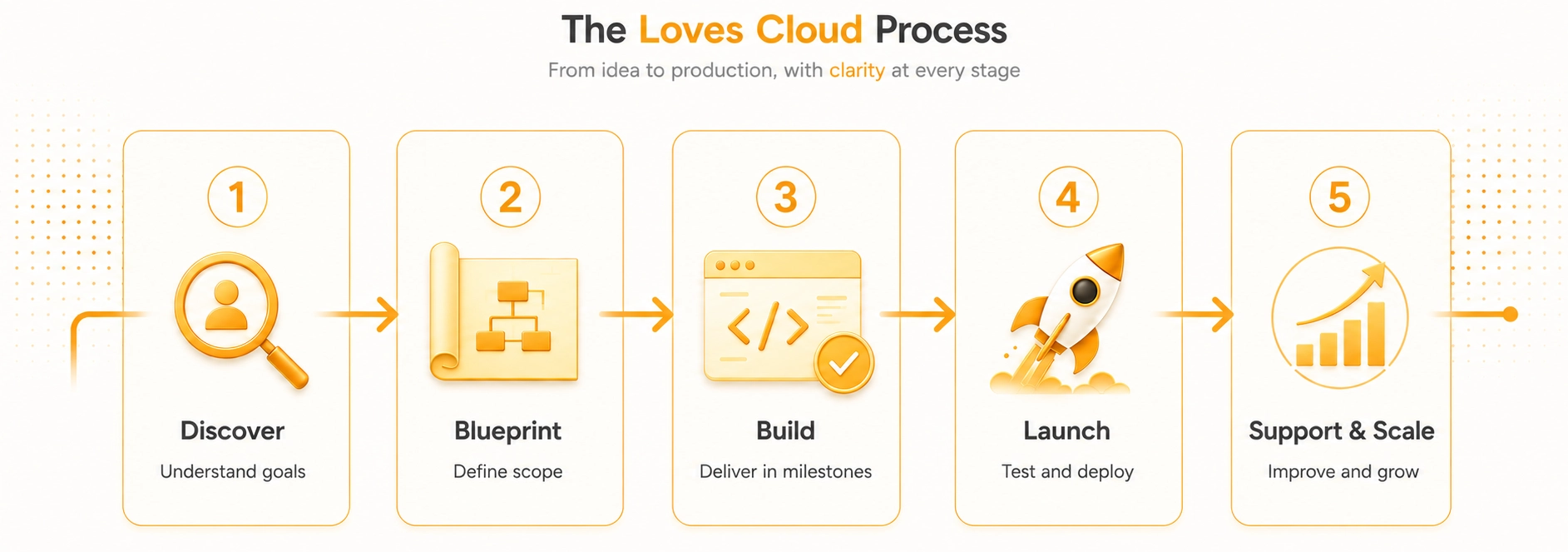
Discovery
Architecture
Milestone Planning
That usually means:
This helps clients get better visibility before serious development effort begins.
It also helps avoid the common problems that make software projects difficult:
Good software delivery is not just about writing code.
It is about making the right decisions early enough that the development work has a clear path.
Better Questions Before You Build Software
Before starting a custom software development project, it is worth asking a few simple questions:
These questions may look basic, but they usually decide whether a software project:
Stays focused, or slowly turns into something bigger, slower, and more expensive than planned.
The best software does not add more complexity to the business.
It removes it.
Helps teams work faster
Helps customers get what they need
Reduces manual work
Improves visibility
A better way to operate
That is the standard more software projects should be held to.
Not just whether the software was built.
But whether it removed the friction it was supposed to remove.
Frequently Asked Questions
Answers to the questions we hear most before a project starts.
A business should consider custom software when an important process has become too manual, too slow, too dependent on spreadsheets, or too difficult to manage with existing tools.
Custom software makes sense when the problem is specific enough, valuable enough, and repeated often enough that solving it properly can save time, reduce errors, improve customer experience, or support growth.
Before software development starts, the team should be clear on the business problem, target users, core workflows, first-version scope, technical architecture, integrations, delivery milestones, risks, and success criteria.
These decisions help reduce scope drift, budget surprises, and rework during development.
Custom software projects often go over budget because the scope is unclear, requirements keep changing, technical risks are discovered too late, or teams begin development before the product and workflow are properly understood.
A discovery and blueprint phase can help identify these issues early and create a clearer delivery plan.
The first version sets the foundation for the product.
If it includes too much, the project can become slow and expensive. If it includes too little, it may not solve a meaningful problem.
A strong first version focuses on the core workflow, creates real value, and gives the business something useful to launch, test, and improve.
Loves Cloud reduces software delivery risk by starting with discovery, architecture, scope definition, and milestone planning before development begins.
We focus on clear deliverables, strong technical planning, fixed-scope milestones, and software that clients can own, operate, and grow with after launch.
Loves Cloud designs and builds SaaS products, AI applications, business software, customer portals, internal platforms, workflow automation systems, and cloud-native applications.
Our focus is on building software that solves real business problems and supports long-term ownership.
Hiring developers usually means giving a team a list of features to build.
Working with a software product development partner means getting help with product decisions, scope definition, architecture, prioritization, risk identification, and milestone planning before and during development.
A good partner helps make sure the right thing is being built, not just that the code is written.
Planning to build a SaaS product, AI application, customer portal, or internal business platform?
Loves Cloud can help you clarify scope, architecture, risks, timeline, and delivery approach before development begins.
Book a Software Project Discovery Call