
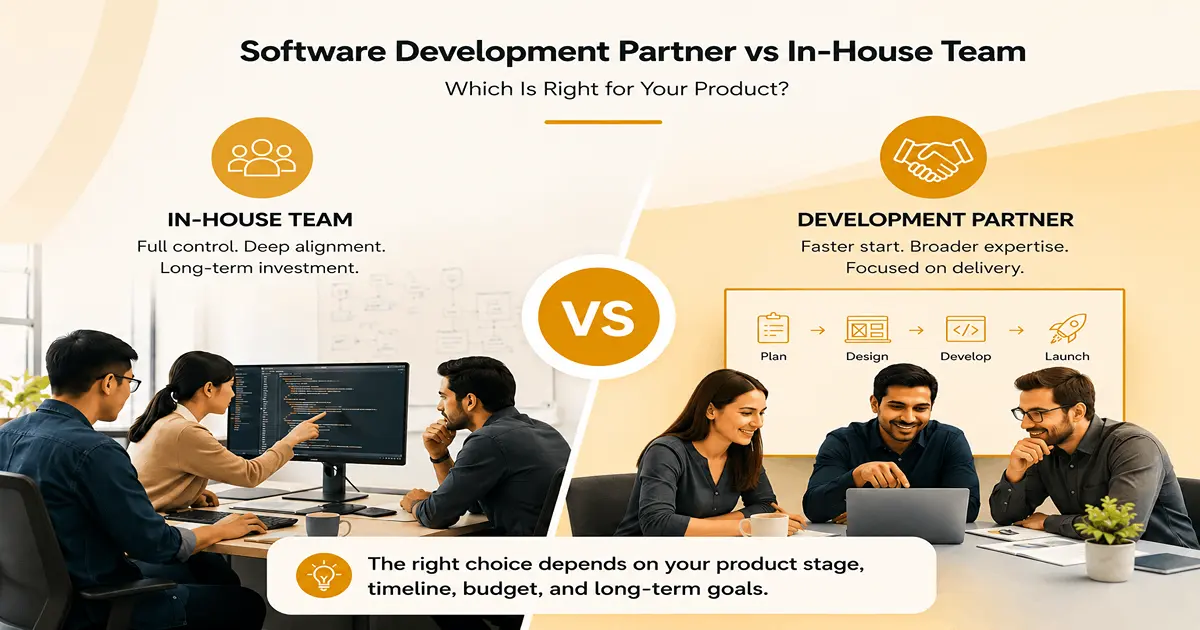
Software Development Partner vs In-House Team: Which Is Right for Your Product?
A good software product can create a new business, improve how an existing company operates or make a previously difficult service much easier to deliver.
Once the idea starts taking shape, one important question usually follows:
Should you build an internal engineering team, or should you work with a software product development partner?
Both can work well. The better choice depends on where your company is today, what you are trying to build and how quickly you need to move.
An in-house team gives you long-term product knowledge, direct control and a permanent engineering capability inside the business. A strong development partner gives you immediate access to product, design, architecture, engineering and quality assurance expertise without having to recruit every role individually.
For some companies, building internally is the obvious long-term choice. For others, working with an experienced partner is the fastest and most practical way to get the product launched. Many companies eventually use a combination of both.
The decision should come down to your product stage, available technical leadership, budget, timeline and long-term plans.
Software Development Partner vs In-House Team: The Quick Answer
An in-house team usually makes sense when software is central to the company’s long-term strategy, there is experienced technical leadership in place and the business is ready to recruit, manage and retain engineers over several years.
A software product development partner makes sense when you need to begin sooner, need a complete team rather than one or two individual hires, or want clearer responsibility around scope, milestones and delivery.
A hybrid model is also common. A company may start with a development partner to design and launch the first version of the product, then build an internal team as the product matures and the roadmap becomes more continuous.
The real question is not whether internal or external development is better. It is which model gives your company the best chance of building the right product at this stage.
What Is an In-House Software Development Team?
An in-house software team is made up of people employed directly by the company. Depending on the size and complexity of the product, that may include engineers, product managers, designers, quality assurance specialists, DevOps engineers and technical leaders.
Because the team works entirely inside the business, it builds a deep understanding of the customers, product roadmap, technical architecture and internal priorities.
Over time, that knowledge becomes valuable. The team is close to the business, can respond quickly to changing priorities and can continue improving the product as the company grows.
For a software company, building a strong internal engineering organisation is often an important long-term investment.
The challenge is that a capable software team involves much more than hiring a few developers.
Someone needs to own architecture, product decisions, engineering quality, testing, cloud infrastructure, security, delivery processes and technical debt. If those responsibilities are unclear, adding more developers may create more activity without creating more progress.
What Is a Software Product Development Partner?
A software product development partner is an external company that helps design, build, test and launch a software product.
This is different from simply hiring a few external developers.
With staff augmentation, the client usually remains responsible for product management, architecture, technical direction and delivery. The external developers contribute capacity, but the company still needs to manage the overall project.
A product development partner should take on a broader role.
It should help understand the business problem, define the product, identify risks, recommend the right architecture, plan the work, build the software, test it and prepare it for production.
A capable partner should not start by asking which programming language you want to use. It should first understand what the product needs to achieve, who will use it and what constraints matter to the business.
The engagement may cover an entire SaaS product, an AI application, a new customer portal, an internal business system or a specific module within an existing platform.
In-House Team vs Software Development Partner
| Consideration | In-House Team | Software Development Partner |
|---|---|---|
| Starting development | Depends on recruitment and team availability | Can begin with an established team |
| Long-term product knowledge | Builds deeply inside the company | Requires deliberate documentation and knowledge transfer |
| Technical capabilities | Roles must be hired or developed internally | Multiple capabilities can be included in one engagement |
| Cost structure | Salaries, benefits, recruitment, tools and management | Project, milestone, retainer or time-based commercial model |
| Delivery ownership | Managed internally | Can be assigned to the partner with defined milestones |
| Ability to scale | Requires further hiring | Team capacity can be adjusted through the engagement |
| Product control | Direct internal control | Shared through governance, scope and approval processes |
| Best suited for | Continuous long-term product development | Defined projects, launches and specialist delivery needs |
The comparison looks simple on paper, but the right choice depends on how these factors apply to your company.
When Building an In-House Development Team Makes Sense
An internal team is often the right choice when software is a long-term strategic capability for the business.
If the company expects to release improvements continuously, run regular product experiments and develop proprietary technology over several years, internal ownership can be valuable.
Here are some situations where building in-house usually makes sense.
You already have strong technical leadership
Hiring developers is only one part of building an engineering organisation.
Someone still needs to make architecture decisions, define coding and testing standards, manage technical debt and make sure engineering priorities stay connected to the business.
A strong CTO, VP of Engineering or senior technical leader can create that structure and help the team grow in the right direction.
Without experienced technical leadership, even a talented team can struggle with delivery, quality and prioritisation.
The product requires continuous development
Some products are always evolving.
They need regular releases, ongoing customer feedback, experiments, integrations and continuous improvements. When there is enough work to support a permanent engineering team, internal development can provide strong continuity.
The team remains close to users and can make product decisions as new information becomes available.
The technology is part of your competitive advantage
If the underlying architecture, algorithms, data models or infrastructure are central to what makes the business valuable, you may want the people building those capabilities to sit inside the company.
This is especially relevant when the technology itself is difficult to reproduce and forms an important part of the company’s intellectual property.
You are ready for the full cost of an internal team
The cost of an in-house team is not limited to salaries.
You also need to account for recruitment, benefits, equipment, cloud environments, engineering tools, management time, training and employee retention.
There is also a cost when someone leaves. Recruiting and onboarding a replacement can interrupt development for months.
An in-house team can be a worthwhile investment, but it should be evaluated as a complete operating commitment.
When a Software Product Development Partner Makes Sense
A product development partner can be a strong option when the business has a clear problem to solve but does not yet have all the people and capabilities required to build the solution internally.
This does not mean the company lacks technical knowledge.
Many organisations with capable internal teams still work with development partners because they need to move faster, add specialist expertise or deliver a separate initiative without pulling the existing team away from its priorities.
You need to launch within a defined timeframe
Recruiting a complete product team often takes longer than expected.
Even after the right people are hired, they still need time to understand the business, agree on technical standards and learn how to work effectively together.
An established development partner already has people who have delivered software as a team. This can reduce the time between approving the project and making meaningful progress.
That speed matters when the launch is tied to customer commitments, fundraising milestones, market timing or a limited runway.
You need more than one developer
A production-ready product normally requires several skills.
You may need product discovery, user experience design, frontend and backend development, cloud architecture, testing, security and deployment support.
Hiring one developer does not give you all of that. Hiring every role internally may not make financial sense for an early-stage product.
A development partner can bring the right mix of skills into the project without requiring the company to create a permanent position for each one.
You want more predictability around cost
Software budgets often become difficult to control when the scope is vague and responsibilities are unclear.
A good development partner should help define the product before development begins, break the work into milestones and agree on what needs to be delivered at each stage.
When the scope is sufficiently clear, a fixed-price and milestone-based model can give founders greater confidence about the overall investment.
This does not mean the scope can never change. New ideas and requirements often emerge during development.
The value of a structured delivery model is that it makes those changes visible. Everyone can see what was included in the original scope and what has been added later.
Your internal team needs additional capacity
Working with an external partner does not mean replacing the internal team.
A partner can take responsibility for a new product, customer portal, AI feature, migration or another clearly defined workstream while the internal team continues supporting the core platform.
This allows the company to increase delivery capacity without rushing into permanent hiring or constantly moving internal engineers between priorities.
You need experience with a particular type of product
A company may understand its customers and industry extremely well but have limited experience building a multi-tenant SaaS platform, an AI application or a cloud-native business system.
A partner that has worked on similar products can help avoid common mistakes around architecture, security, integrations, scaling and deployment.
That experience matters because many of the most expensive product decisions are made early, long before the cost of those decisions becomes visible.
The real value of an experienced partner is not simply access to developers. It is access to better decisions.
The Hybrid Model: Start with a Partner, Build Internally Over Time
For many founders, the most practical model is a combination of internal and external development.
Plan & Build
A development partner can help turn the initial idea into a defined product, create the architecture, build the first production version and document how the system works.
Grow the Team
As the product gains customers and the roadmap becomes more predictable, the company can start building its own engineering team.
Share Ownership
The partner may continue supporting specific modules, infrastructure or future releases, or ownership may gradually move to the internal team.
Long-Term Growth
The company builds its engineering organisation around a real product, real customers and a clearer roadmap instead of making early hiring decisions based on assumptions.
The transition needs to be planned properly. Knowledge transfer should not begin during the final week of the project. Architecture decisions, repositories, deployment procedures, credentials, testing processes and operating responsibilities should be documented throughout the engagement.
Seven Questions to Ask Before Choosing
How soon does development need to begin?
If the business can spend several months recruiting and building the team properly, an in-house approach may be realistic.
If the opportunity depends on launching within a defined window, an established product team may be the better choice.
Do you already have someone who can lead engineering?
Developers need clear technical and product direction.
If experienced engineering leadership already exists inside the business, you have a stronger foundation for internal hiring.
If it does not, a development partner that can provide architecture and delivery leadership may reduce risk.
Is the work continuous or project-based?
A permanent team makes sense when there is enough ongoing work to keep it focused over the long term.
An external partner may be better suited to a defined product, module, migration or product launch.
How clear is the product scope?
A clear scope supports milestone-based planning and, in some cases, fixed-price delivery.
If the product direction is likely to change every week, the project may need a more flexible model.
That may mean working on a time-and-materials basis, running a discovery phase first or keeping more product ownership inside the company.
Which capabilities do you actually need?
Do not stop at the programming languages.
Think about the complete team required to deliver the product successfully.
You may need product strategy, user experience design, application architecture, cloud infrastructure, security, quality assurance and DevOps.
This exercise often reveals whether you are hiring one person or trying to create an entire delivery organisation.
What is the full cost of each model?
For an internal team, include recruitment, salaries, benefits, management, tools, equipment and replacement costs.
For a development partner, include discovery, development, change requests, support and the internal time needed to manage the relationship.
The useful comparison is not salary versus vendor pricing. It is the total investment required to achieve the expected product outcome.
What happens after launch?
Every product needs some level of monitoring, support, maintenance and improvement.
Before choosing either model, decide who will own the product after launch, how defects will be handled and how future development will be planned.
A successful launch is only the beginning of the product lifecycle.
How to Choose the Right Software Product Development Partner
Choosing a partner should involve more than comparing rates or checking whether a company works with a particular technology.
The partner will influence the product architecture, user experience and early delivery decisions. Founders should look closely at how the company approaches the complete project.
Look for relevant product experience
A company that has built SaaS products should understand multi-tenancy, subscriptions, user management, integrations, data isolation and product analytics.
An AI application requires more than connecting to a model API. The team may need to think about evaluations, guardrails, data privacy, retrieval quality, usage costs and human review.
Relevant experience helps the partner ask better questions before development begins.
Pay attention to the scoping process
A credible partner should want to understand the business problem, target users, workflows, technical constraints and definition of success.
Be cautious when a company provides a confident price and timeline before it has properly understood what needs to be built.
Good scoping does not slow down development. It prevents expensive misunderstandings later.
Ask how milestones are defined
A milestone should represent a meaningful outcome, not simply a number of weeks spent working.
Each milestone should include agreed deliverables, responsibilities and acceptance criteria.
This makes progress visible and gives both sides a shared understanding of what has actually been completed.
Choose the right commercial model
Time and materials can work well when the requirements are expected to change regularly and the company wants maximum flexibility.
Fixed-price delivery can work well when the scope is sufficiently defined and the business needs greater budget predictability.
Neither commercial model can compensate for weak scoping, poor communication or unclear ownership.
The right structure is the one that matches the amount of certainty in the project.
Confirm ownership and access
The contract should clearly explain who owns the source code, designs, documentation and intellectual property.
It should also cover access to repositories, cloud accounts, development environments and third-party services.
A client should not discover at the end of a project that critical systems or credentials are controlled entirely by the supplier.
Understand who is accountable for delivery
There is an important difference between hiring external developers and working with a product development partner.
External developers may contribute code while the client manages product direction, architecture, testing and delivery.
A product partner should take broader responsibility for the outcome and clearly explain what it will own and what it still needs from the client.
Why the Delivery Model Matters
Common Delivery Risks
Projects become difficult when the scope is unclear, key decisions have no clear owner, milestones are based only on time spent and acceptance criteria are introduced after the work is complete.
Define the Right Process
A stronger delivery process begins by defining the business problem, users, workflows and expected outcomes. The product can then be divided into meaningful milestones with clear deliverables and responsibilities.
Deliver with Confidence
This is especially important for founders who need to manage capital carefully. They need to know what the next investment will produce, which decisions are required from them and how progress will be measured.
Predictable delivery does not mean pretending that software development contains no uncertainty. It means identifying uncertainty early, documenting assumptions and creating a clear process for handling changes.
Which Model Is Right for Your Product?
Build an In-House Team
Build an in-house team when the company is ready to create a permanent engineering capability, has the leadership required to manage it and expects continuous product development for years.
Work with a Development Partner
Work with a software product development partner when you need to start sooner, require a complete multidisciplinary team, want clearer delivery accountability or need more predictability around the budget.
Choose a Hybrid Approach
Consider a hybrid approach when you need to launch now but expect to build internal engineering capability as the business grows.
The right choice should support the company’s current stage and long-term strategy. It should help you build the right product without forcing the business into an operating model it is not yet ready to manage.
Building Your Product with Loves Cloud
Built by Product Builders
At Loves Cloud, we have spent years building software products ourselves, including cloud management platforms, AI-powered SaaS products and business automation solutions.
That experience has shaped how we work with founders and businesses.
Start with the Right Plan
We begin by understanding the problem, the users and the outcome the product needs to create.
From there, we define the scope, architecture, milestones, risks and delivery plan before moving into development.
Products We Build
Our software product development work includes SaaS platforms, AI applications, business software, customer portals and data-driven applications.
Where the scope is clear, we use a fixed-price, milestone-based delivery model designed to provide greater predictability around cost, progress and output.
A True Product Development Partner
Our role is not to supply developers and leave the client to manage everything else.
It is to act as a product development partner that takes responsibility for turning a well-defined idea into working software.
Frequently Asked Questions
The better option depends on your company's stage, timeline, available technical leadership and long-term product roadmap.
An in-house team can provide strong long-term ownership and product knowledge. A software development partner can help you start sooner and access a broader range of capabilities without building the complete team internally.
Many companies use both models at different stages.
A startup should consider working with a development partner when it needs to launch within a defined timeframe, does not yet have a complete engineering team or needs specialist product experience.
It can also make sense when the startup wants clearer project milestones and more predictability around development costs.
It can reduce the need for permanent hiring and the associated operating costs, but price should not be the only factor.
The decision should consider speed, quality, delivery responsibility, internal management time and long-term product needs.
The lowest-priced proposal is not always the lowest-cost option once delays and rework are considered.
Yes.
A development partner can take responsibility for a specific product, module or workstream while the internal team continues supporting the main platform.
This works best when responsibilities, technical standards and communication processes are agreed from the beginning.
Outsourcing MVP development can make sense when the startup needs a complete product team and wants to validate the market before creating a permanent engineering organisation.
The MVP should still be built with clear ownership, proper documentation and a sensible path for future development.
Ownership should be clearly defined in the contract before development begins.
The agreement should cover the source code, designs, intellectual property, documentation, repositories, cloud infrastructure and third-party components.
Look at the partner's relevant product experience, scoping process, proposed team, architecture capability, delivery model, communication practices and post-launch support.
You should also ask who will be accountable for the final outcome and how progress will be measured.
Fixed-price development can provide greater predictability when the scope and acceptance criteria are clear.
Time and materials can provide more flexibility when the product direction is likely to change regularly.
The right model depends on how well the project can be defined before development begins.
Yes.
A development partner can help establish the product, architecture and documentation while the company gradually recruits its internal team.
The transition will be smoother when knowledge transfer, access and documentation are planned from the beginning.
A strong proposal should include the business objective, product scope, deliverables, milestones, responsibilities, assumptions, exclusions, architecture approach, testing process, timeline, commercial terms and acceptance criteria.
It should make clear what will be delivered, what the client needs to provide and how completion will be evaluated.
Planning to build a SaaS product, AI application, customer portal, or internal business platform?
Loves Cloud can help you clarify scope, architecture, risks, timeline, and delivery approach before development begins.
Book a Software Project Discovery Call